
SolGel refers to a chemical reaction that facilitates the growth of colloidal particles, known as 'Sol,' and their subsequent network formation. The precursors used to synthesize these colloids typically consist of a metal or metalloid element surrounded by various reactive ligands.
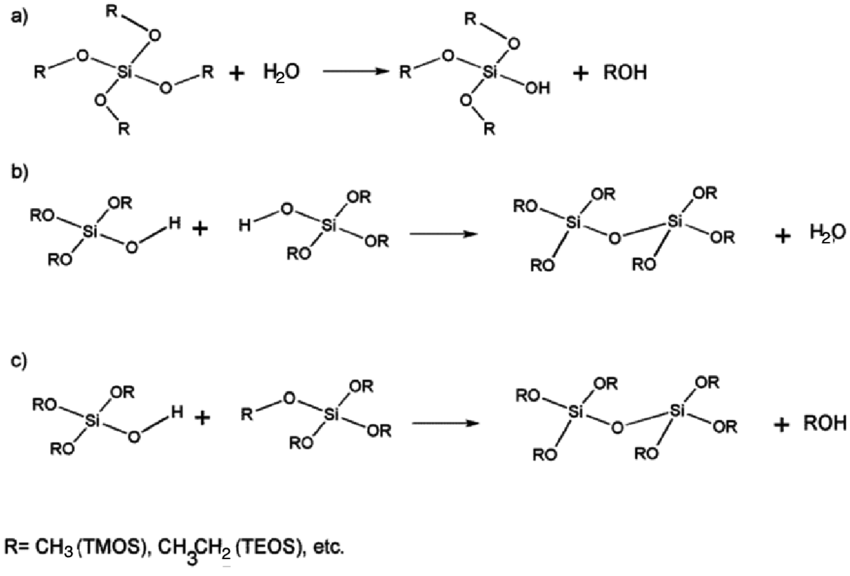
Various organosilanes can be used in the SolGel, Aerogel, and Xerogel processes, with Alkoxysilanes being the primary group. BRB offers a range of alkoxysilanes suitable for this application.
BRB ALKOXY SILANES
| Product | Chemical name | Formula | CAS no. | Purity |
|---|---|---|---|---|
| BRB Silanil 294 | N-octyltriethoxysilane | (CH3CH2O)3Si-(CH2)7-CH3 | 2943-75-1 | ≥ 95% |
| BRB Silanil 118 | Methyltrimethoxysilane | (CH3O)3Si-CH3 | 1185-55-3 | ≥ 98% |
| BRB Silanil 150 | Propyltrimethoxysilane | (CH3O)3Si-CH2CH2CH3 | 1067-25-0 | ≥ 97% |
| BRB Silanil 203 | Methyltriethoxysilane | (CH3CH2O)3Si-CH3 | 2031-67-6 | ≥ 98% |
| BRB Silanil Si28 | Tetraethoxysilane | (CH3CH2O)4Si | 78-10-4 | ≥ 99% |
| BRB Silanil Si40 | Tetraethoxysilane oligomer | Oligomer | 68412-27-3 | N.A. |
Coatings produced using the SolGel technique offer several key advantages, including:
- Corrosion resistance;
- Scratch protection;
- Heat and UV resistance;
- Easy to clean anti-fingerprint and anti-graffiti properties.
Coatings produced can be applied using a deposit technique that allows for the creation of an extremely thin material layer. This method is widely used in industries such as architecture, automotive, solar energy, and cosmetics.
For more information about our silane portfolio, please contact your local sales representative.
If you are new to our organization, please visit BRB Silicones Contact-us to find the appropriate contact for your region.