
BRB Silanil® 442 goes by CAS number 4420-74-0 and its mercapto (SH) functionality makes it a very versatile silane which combines well with natural rubbers.
The combination of functionalities, as shown below in the chemical structure, gives BRB Silanil® 442 that extra which makes it a remarkable organofunctional silane.

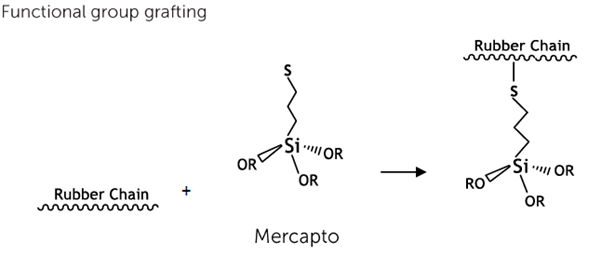
BRB Silanil® 442 is very suitable for grafting the organofunctional silane (OFS) onto the rubber chain before the vulcanization process begins. This process is called functional grafting:
The second step is to hydrolyze the methoxy groups, which then bond to the filler by condensation with the OH groups on the filler surface.
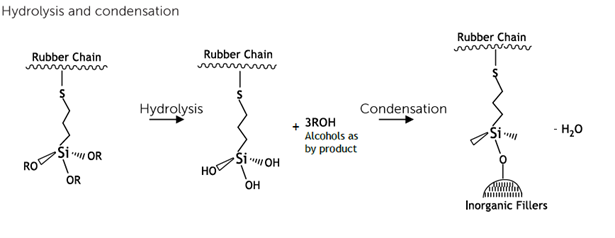
When BRB Silanil® 442 is mixed into a rubber compound it needs to be combined with a mineral filler like silica or clay before adding the vulcanizing agent.
A big advantage is that BRB Silanil® 442 will reduce the Mooney viscosity of the compound and will prevent scorch during the vulcanization process.
Other applications of BRB Silanil® 442 include:
Surface functionalization:
- Forms self-assembled monolayers (SAM’s) on glass, silicone, gold and metal oxides.
- Used in e.g., gold surface modification for biosensors.
Mineral treatment for water treatment applications:
Functionalizing clay or silica for heavy metal absorption.
Thiol-ene chemistry
Thiol-ene chemistry has gained significant attention in recent years due to its 'click' nature, enabling rapid, efficient, and oxygen-insensitive polymerization. BRB Silanil® 442, with its thiol (-SH) and trimethoxysilane (-Si(OCH₃)₃) functionalities, serves as a critical coupling agent in the synthesis of thiol-functionalized nanomaterials and their integration into polymer matrices.
The mechanism involves two key steps:
- Hydrolysis and condensation of BRB Silanil® 442 with silica surfaces to form thiol-functionalized nanoparticles.
- UV-initiated thiol-ene reaction between the thiol groups and vinyl monomers in the polymer matrix.
SiO2-OH + BRB Silanil® 442 → SiO2-O-Si(CH3O)2-(CH2)3-SH
SH +CH2=CH- → [UV] → Crosslinked Thiol-Ene Polymer
BRB Silanil® 442-modified silica nanoparticles are incorporated into thiol-ene resin systems such as Bis-GMA and TMPTMP. Upon UV curing, the thiol groups participate in radical-mediated addition to vinyl groups, forming covalent bonds within the matrix. This results in improved dispersion, reduced agglomeration, and enhanced mechanical properties of the final polymer.
Key benefits include:
- Up to 77% increase in tensile strength
- Improved UV-curing efficiency
- Applications in coatings, adhesives, dental materials, and optical films
For more information, please contact your local sales representative.