

In the world of RTV-2 (Room Temperature Vulcanizing) silicones, crosslinkers play a decisive role in defining mechanical performance, processing behavior, and cure kinetics. Among the most critical are SiH-functional crosslinkers, which react with vinyl-functional polydimethylsiloxanes (PDMS) under platinum-catalyzed hydrosilylation to form the durable Si–CH₂–CH₂–Si network that gives silicone elastomers their unique balance of flexibility and strength.
BRB offers a comprehensive range of crosslinkers and chain extenders to support diverse formulations needs.
What are SiH Crosslinkers?
SiH crosslinkers are organosilicon compounds that contain multiple silicon-hydrogen (Si–H) groups per molecule. When
mixed with vinyl-terminated PDMS, these groups react via hydrosilylation, forming covalent bridges between polymer
chains.
The reaction rate follows second-order kinetics:
r = k [Si–H] [CH=CH₂]
where the rate constant k depends on temperature, catalyst concentration, and the type of inhibitor used.
Key parameters influencing the reaction include:
- SiH content: number of reactive hydride groups
- Viscosity and molecular weight of the crosslinker
- Vinyl content of the base polymer
- Catalyst and inhibitor balance
The Effect of SiH Content and Crosslinker Viscosity
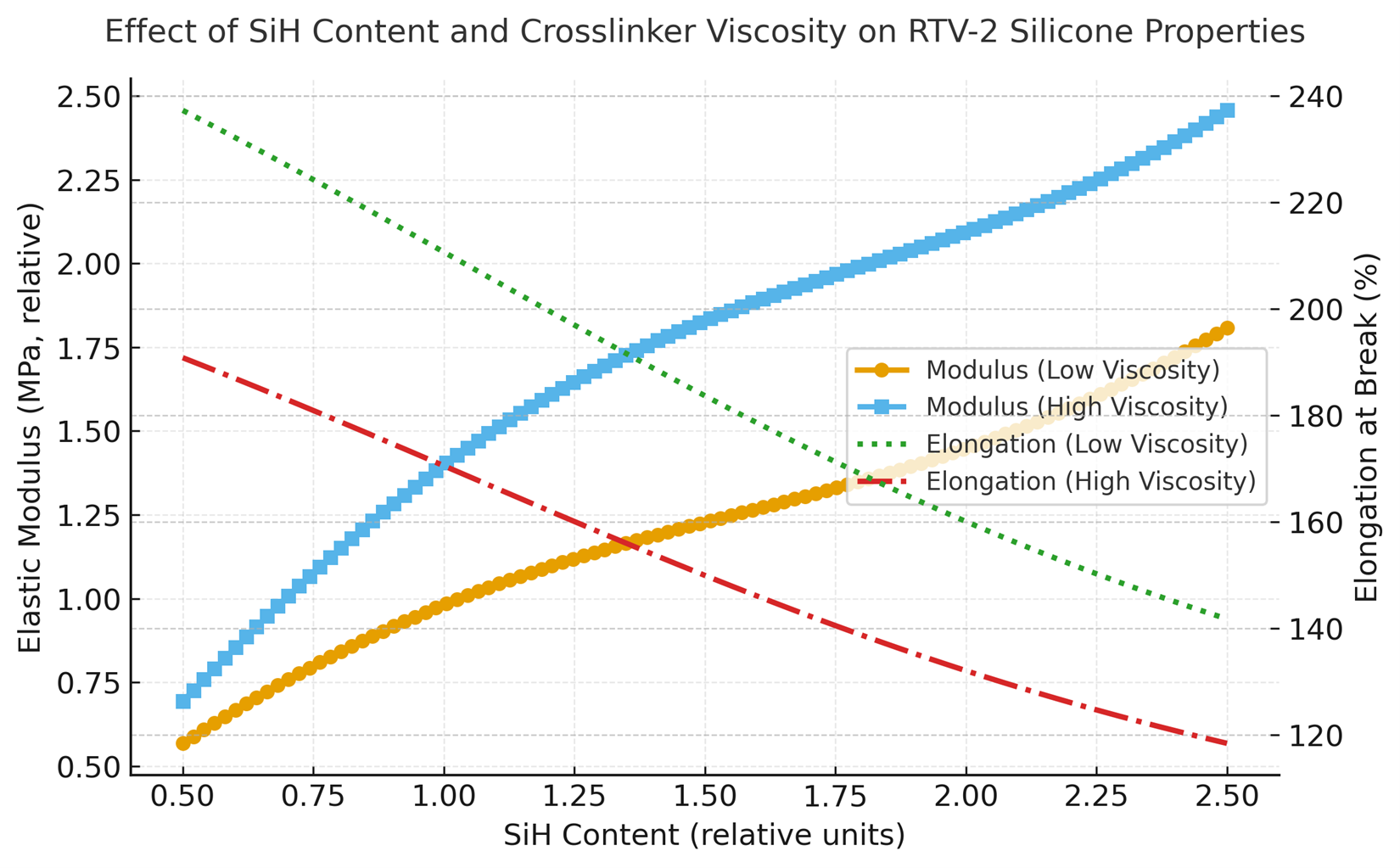
The SiH content of a crosslinker directly determines crosslink density, while viscosity affects mixing, flow, and
network uniformity.
| Parameter | High SiH content | Low SiH content |
|---|---|---|
| Crosslink density | ↑ Higher (stiffer network) | ↓ Lower (softer elastomer) |
| Cure rate | ↑ Faster | ↓ Slower |
| Shrinkage | ↑ More | ↓ Less |
| Elastic modulus | ↑ Increases | ↓ Decreases |
Similarly:
Low-viscosity crosslinkers → Better flow, uniform cure, longer pot life High-viscosity crosslinkers → Stiffer networks, ideal for structural silicones
Effect of SiH Content and Crosslinker Viscosity on RTV-2 Silicone Properties
The graph below illustrates the relationship between SiH content and key performance indicators such as modulus and
elongation for low- and high-viscosity crosslinkers.
BRB’s Range of Crosslinkers
| BRB product name | Type of SiH | Viscosity (cSt) | SiH content (mmol/g) |
|---|---|---|---|
| BRB Crosslinker 434H4 | Pendant | 50 | 4.0 |
| BRB Crosslinker 1595H7 | Pendant | 30 | 7.0 |
| BRB Crosslinker 1738H1.9 | Pendant | 53 | 1.9 |
| BRB Crosslinker 959H2.5 | Pendant & end-capped | 30 | 2.5 |
The Role of Chain Extenders
While crosslinkers build the 3D network, chain extenders modify the polymer chain length before crosslinking occurs.
| Component | Structure | Function |
|---|---|---|
| Crosslinker | PDMS backbone with in-chain SiH groups | Create network junctions |
| Chain Extender | PDMS backbone end-capped with SiH groups | Extend chains linearly before curing |
The combination of both enables formulators to fine-tune elasticity, mechanical strength, cure rate, and pot life. By adjusting the ratio of crosslinkers to chain extenders, materials can range from soft gels to tough elastomers.
BRB’s Range of Chain Extenders
| Product name |
Type of SiH |
Viscosity (cSt) |
SiH content (mmol/g) |
|---|---|---|---|
| BRB Modifier 1439 | End-capped | 5 | 2.5 |
| BRB Modifier 1449 | End-capped | 13 | 1.3 |